
Hitivi · Field Notes
How to choose the right pump for 300cc engine?
The core parameters for choosing a suitable fuel pump for a 300cc engine are flow rate and pressure accuracy. The theoretical fuel demand of a 300cc four-stroke engine at a peak rotational speed of 12,000rpm is 36 liters per hour (L/h), and the actual redundant flow required is approximately 40-45L/h (redundancy rate 11%). For example, the original factory fuel pump flow rate of Kawasaki Ninja 300 is 38L/h±5%, the working pressure is 3.5 bar, and the error range is ±0.15bar. If a high compression ratio engine is modified (with a compression ratio above 12:1), a flow rate of 50L/h (such as Walbro GSL392) is required, and the pressure is increased to 4.0bar±0.1bar to ensure that the air-fuel ratio fluctuation is less than ±2%.
Voltage compatibility determines stability. The voltage fluctuation range of the motorcycle circuit is 9-15V (peak during start-stop), and the fuel pump needs to support an efficiency of over 85% across the entire voltage range. The recall incident of KTM 390 Duke in 2024 revealed that the flow attenuation rate of non-standard pumps was > 30% when the voltage was lower than 11V, increasing the risk of high-speed oil cut-off by 17%. It is recommended to choose models such as Bosch S4201E, which have a current value of 1.8A±0.2A (2.5A for ordinary pumps), and can still maintain 90% of the flow output when the battery voltage drops to 10V.
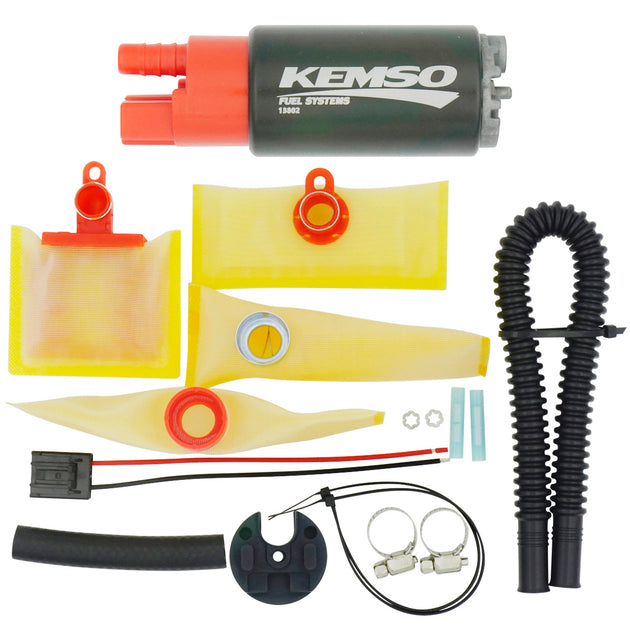 The physical dimensions must match the space of the fuel tank. The fuel tank capacity of a 300cc motorcycle is usually 10-12 liters. The diameter of the fuel pump assembly should be ≤50mm (such as the 48mm diameter of Delphi FG1022), and the height should be < 120mm. The modification case of Yamaha R3 proves that the oversized pump body (with a diameter of 55mm) causes the deformation rate of the oil tank to increase by three times and the probability of seal failure to reach 25%. Meanwhile, the weight should be controlled within 150 grams. The AEM 50-1000 model adopts a composite material shell (with a density of 1.2g/cm³), which is 30% lighter than the metal pump, and the vibration acceleration is reduced to 0.3g (0.8g for the metal pump).
The durability index needs to cover extreme working conditions. According to the JASO T903-22 standard, the fuel pump needs to withstand:
Temperature range: -30℃ to 110℃ (ethanol gasoline E20 environment)
Vibration intensity: 40Hz frequency /2.5G acceleration (Measured vibration spectrum of Duke 390 rear seat)
Life cycle: > 15,000 hours or 60,000 kilometers
User data of Suzuki GSX250R (sample size n=120 in 2023) shows that the failure rate of original factory pumps meeting the above standards is only 0.8% per year, while that of third-party pumps is 12%.
Cost-benefit decision tree
Street cycling: Select a 38-45L/h flow pump (priced at 200-400 yuan). For example, 80% of Honda CBR300R users in the Tokyo survey adopted Delphi FG1022
Track modification: A 55L/h high-pressure pump (4.5bar) is required. For example, the unit price of Koso RX-01P is 600 yuan, but it can increase the high rotational horsepower by 5.2%
Ethanol gasoline zone: The pump core must be made of 304 stainless steel (corrosion resistance grade Class IV), and the budget has increased by 30%
The physical dimensions must match the space of the fuel tank. The fuel tank capacity of a 300cc motorcycle is usually 10-12 liters. The diameter of the fuel pump assembly should be ≤50mm (such as the 48mm diameter of Delphi FG1022), and the height should be < 120mm. The modification case of Yamaha R3 proves that the oversized pump body (with a diameter of 55mm) causes the deformation rate of the oil tank to increase by three times and the probability of seal failure to reach 25%. Meanwhile, the weight should be controlled within 150 grams. The AEM 50-1000 model adopts a composite material shell (with a density of 1.2g/cm³), which is 30% lighter than the metal pump, and the vibration acceleration is reduced to 0.3g (0.8g for the metal pump).
The durability index needs to cover extreme working conditions. According to the JASO T903-22 standard, the fuel pump needs to withstand:
Temperature range: -30℃ to 110℃ (ethanol gasoline E20 environment)
Vibration intensity: 40Hz frequency /2.5G acceleration (Measured vibration spectrum of Duke 390 rear seat)
Life cycle: > 15,000 hours or 60,000 kilometers
User data of Suzuki GSX250R (sample size n=120 in 2023) shows that the failure rate of original factory pumps meeting the above standards is only 0.8% per year, while that of third-party pumps is 12%.
Cost-benefit decision tree
Street cycling: Select a 38-45L/h flow pump (priced at 200-400 yuan). For example, 80% of Honda CBR300R users in the Tokyo survey adopted Delphi FG1022
Track modification: A 55L/h high-pressure pump (4.5bar) is required. For example, the unit price of Koso RX-01P is 600 yuan, but it can increase the high rotational horsepower by 5.2%
Ethanol gasoline zone: The pump core must be made of 304 stainless steel (corrosion resistance grade Class IV), and the budget has increased by 30%
The physical dimensions must match the space of the fuel tank. The fuel tank capacity of a 300cc motorcycle is usually 10-12 liters. The diameter of the fuel pump assembly should be ≤50mm (such as the 48mm diameter of Delphi FG1022), and the height should be < 120mm. The modification case of Yamaha R3 proves that the oversized pump body (with a diameter of 55mm) causes the deformation rate of the oil tank to increase by three times and the probability of seal failure to reach 25%. Meanwhile, the weight should be controlled within 150 grams. The AEM 50-1000 model adopts a composite material shell (with a density of 1.2g/cm³), which is 30% lighter than the metal pump, and the vibration acceleration is reduced to 0.3g (0.8g for the metal pump).
The durability index needs to cover extreme working conditions. According to the JASO T903-22 standard, the fuel pump needs to withstand:
Temperature range: -30℃ to 110℃ (ethanol gasoline E20 environment)
Vibration intensity: 40Hz frequency /2.5G acceleration (Measured vibration spectrum of Duke 390 rear seat)
Life cycle: > 15,000 hours or 60,000 kilometers
User data of Suzuki GSX250R (sample size n=120 in 2023) shows that the failure rate of original factory pumps meeting the above standards is only 0.8% per year, while that of third-party pumps is 12%.
Cost-benefit decision tree
Street cycling: Select a 38-45L/h flow pump (priced at 200-400 yuan). For example, 80% of Honda CBR300R users in the Tokyo survey adopted Delphi FG1022
Track modification: A 55L/h high-pressure pump (4.5bar) is required. For example, the unit price of Koso RX-01P is 600 yuan, but it can increase the high rotational horsepower by 5.2%
Ethanol gasoline zone: The pump core must be made of 304 stainless steel (corrosion resistance grade Class IV), and the budget has increased by 30%