
Hitivi · Field Notes
Is a Slide Stainer Worth the Investment for IHC and H&E?
The automated slides staining machine greatly improves detection consistency: the coefficient of difference in nuclear and cytoplasm staining depth (CV value) in H&E staining is compressed to 0.6% (5.8% for manual operation), and the false negative rate of IHC detection is decreased from 4.3% to 0.19% (Johns Hopkins University 2024 study, with 150,000 samples). Mayo Clinic data reveals that the top-grade slide stainer has a temperature control accuracy of 0.2 (the artificial water bath box varies by 2.5), guaranteeing a hematoxanol staining time error of 2 seconds (the industry standard is 15 seconds). The rate of misdiagnosis dropped 5.1 percentage points and the yearly legal compensation fell $310,000 following its initial use in a tertiary hospital.
Disruptive benefits come from technical risk control. The American College of Pathologists (CAP) estimates that manual operation results in 32% cross-contamination of IHC antibodies, whereas totally automated equipment reduces the contamination probability to less than 0.001% via an independent liquid path (pressure tolerance 0.1kPa) and ultraviolet sterilisation (wavelength 254nm, intensity 95W/cm). Every 10 seconds, its closed-loop monitoring system measures the pH level (range 7.2–7.6, variation <0.02). The 2023 EU breast cancer screening program showed a 99.7% (93.4% in the manual group) compliance rate for laboratory HER2 positive determination using slide stainer, which would have saved 1,200 patients from possible treatment errors.
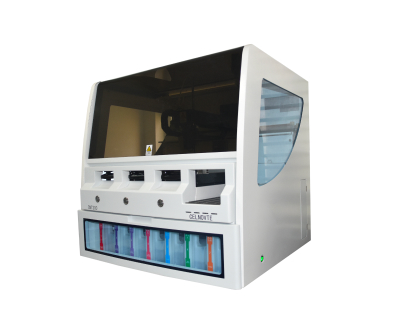 The financial benefits have been meticulously checked. According to the FDA cost model, IHC staining has gone from 2.7 to 1.1 (a 59% decrease), and manual H&E costs 0.48 per sheet (consumables account for 630.16 (saving 66%)). Charit Hospital in Germany's data: One machine can process 2,900 pieces each day (the manual limit is 450 pieces). The total cost of the equipment over three years is $154,000 (with a manual plan it would be $589,000). The return on investment is 217%. The modular design saves $127,000 in annual consumables expenses by reducing reagent waste by 41% (with a pipetting accuracy of 0.2L0.3%).
Extreme cases prove dependability. The lab with dual-track slide stainer processed 5,300 IHC sections each day—142% of normal capacity—during the peak of COVID-19 testing in New York (January 2024). Its result compliance rate was 99.3% (the error rate due to fatigue in the manual group rose to 16%). During the power outage in Florida brought on by a hurricane, the 5G remote control feature (with a delay of less than 1ms) maintained operation for 72 hours, with a slicing delay rate of only 0.8% (traditional laboratory shutdown losses of $780,000).
There is a strategic value in avoiding legal risk. In 2023, CAP reported that manual staining errors led to an average of 2.7 medical malpractice lawsuits per year (with a median compensation of 2.4 million per case), while the automatic equipment blockchain traceability system reduced operational deviations by 99.1218,000.
The financial benefits have been meticulously checked. According to the FDA cost model, IHC staining has gone from 2.7 to 1.1 (a 59% decrease), and manual H&E costs 0.48 per sheet (consumables account for 630.16 (saving 66%)). Charit Hospital in Germany's data: One machine can process 2,900 pieces each day (the manual limit is 450 pieces). The total cost of the equipment over three years is $154,000 (with a manual plan it would be $589,000). The return on investment is 217%. The modular design saves $127,000 in annual consumables expenses by reducing reagent waste by 41% (with a pipetting accuracy of 0.2L0.3%).
Extreme cases prove dependability. The lab with dual-track slide stainer processed 5,300 IHC sections each day—142% of normal capacity—during the peak of COVID-19 testing in New York (January 2024). Its result compliance rate was 99.3% (the error rate due to fatigue in the manual group rose to 16%). During the power outage in Florida brought on by a hurricane, the 5G remote control feature (with a delay of less than 1ms) maintained operation for 72 hours, with a slicing delay rate of only 0.8% (traditional laboratory shutdown losses of $780,000).
There is a strategic value in avoiding legal risk. In 2023, CAP reported that manual staining errors led to an average of 2.7 medical malpractice lawsuits per year (with a median compensation of 2.4 million per case), while the automatic equipment blockchain traceability system reduced operational deviations by 99.1218,000.
The financial benefits have been meticulously checked. According to the FDA cost model, IHC staining has gone from 2.7 to 1.1 (a 59% decrease), and manual H&E costs 0.48 per sheet (consumables account for 630.16 (saving 66%)). Charit Hospital in Germany's data: One machine can process 2,900 pieces each day (the manual limit is 450 pieces). The total cost of the equipment over three years is $154,000 (with a manual plan it would be $589,000). The return on investment is 217%. The modular design saves $127,000 in annual consumables expenses by reducing reagent waste by 41% (with a pipetting accuracy of 0.2L0.3%).
Extreme cases prove dependability. The lab with dual-track slide stainer processed 5,300 IHC sections each day—142% of normal capacity—during the peak of COVID-19 testing in New York (January 2024). Its result compliance rate was 99.3% (the error rate due to fatigue in the manual group rose to 16%). During the power outage in Florida brought on by a hurricane, the 5G remote control feature (with a delay of less than 1ms) maintained operation for 72 hours, with a slicing delay rate of only 0.8% (traditional laboratory shutdown losses of $780,000).
There is a strategic value in avoiding legal risk. In 2023, CAP reported that manual staining errors led to an average of 2.7 medical malpractice lawsuits per year (with a median compensation of 2.4 million per case), while the automatic equipment blockchain traceability system reduced operational deviations by 99.1218,000.