
Hitivi · Field Notes
QC Checkpoints for a Seasonal Private Label Fragrance Range
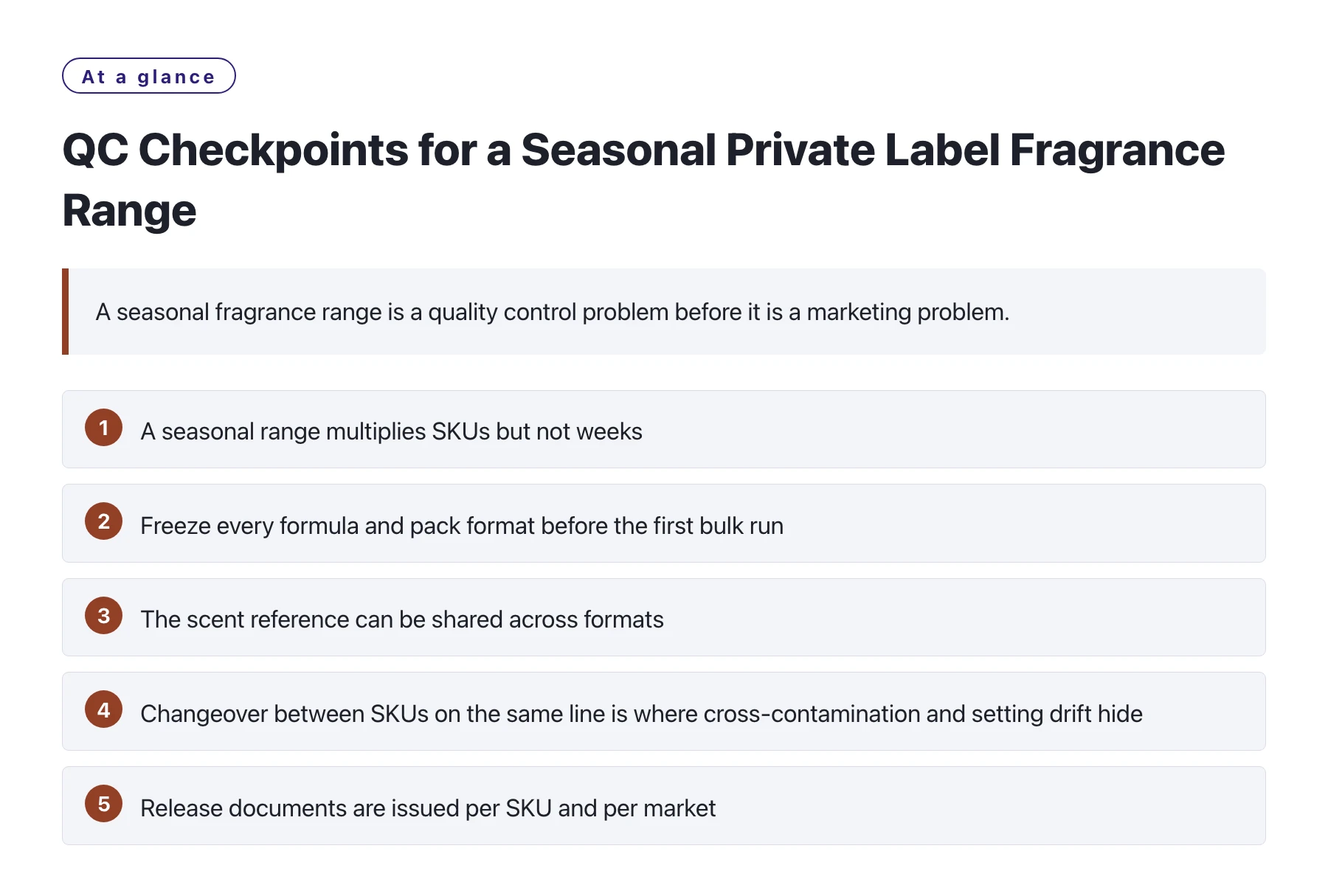
A seasonal fragrance range is a quality control problem before it is a marketing problem. Several scents, several formats and one gifting window stack the checkpoints that a single-SKU launch spreads across months into a few weeks. The fix is decided before compounding starts: which gates cover the whole range, which belong to each SKU, and which reference owns each scent. Ranges that line those decisions up ship on time; ranges that leave them open ship late, wrong, or both.
Key takeaways
- A seasonal range multiplies SKUs but not weeks, so quality control gates have to be shared across products rather than repeated for each one.
- Freeze every formula and pack format before the first bulk run, because one mid-season change invalidates the retained reference for the whole range.
- The scent reference can be shared across formats, but the finished-unit check cannot: pump, fill weight, closure and artwork differ by SKU.
- Changeover between SKUs on the same line is where cross-contamination and setting drift hide, which is why a first-article check on every changeover beats one large final inspection.
- Release documents are issued per SKU and per market, and gifting markets each carry their own labelling expectations [1].
Seasonal collections are built backwards. The gifting window is fixed months in advance, the range is sized to fit it, and every production stage is scheduled from the launch date rather than toward it.
That reverse calendar is survivable, because retailers run it every year. It only works if quality control is planned the same way: as a sequence of shared gates that protect the whole collection, instead of one inspection per product at the end.
Why a range changes the QC plan
A single private label perfume has one scent, one bottle and one document set. A seasonal range has several scents, several formats and one deadline, and every combination is a separate SKU with its own filling, its own labelling and its own release paperwork.
What keeps that manageable is that most checkpoints are shared. One fragrance development gate covers the scents, one tooling gate covers the bottles, one supplier audit covers the plant. The genuinely per-SKU work — fill weight, artwork, release documents — is the narrow remainder, and it is exactly the part that gets skipped when the calendar is tight.
Shared gates versus per-SKU gates
Separate the two lists early. Shared gates are the concentrate approval with use limits assessed per product category [2], component tooling, decoration standards and stability testing. Per-SKU gates are fill weight tolerance, closure torque, batch code, label placement and release documents. Ranges fail when a per-SKU item is treated as shared, or the reverse.
The reference problem in a range
A range needs one retained reference per scent and one per SKU, and the two lists are different. The scent reference travels across formats; the SKU reference is specific to a bottle, a pump and a label. If the brand keeps only the scent reference, a later substitution of the pump or bottle cannot be compared against anything real.
The QC sequence for a compressed calendar
- Approve the scent family in one roundBrief all the scents together and review them against one another, because range balance is a single decision. This is cheaper than approving each scent alone and discovering that the collection clashes.
- Freeze every formula and pack before bulkOne SKU changed mid-season invalidates shared references and re-opens testing for the whole range. The freeze is the gate.
- Set up changeover first-article checksEvery time the line switches from one SKU to the next, check the first unit: fill, cap, code, label. Setting drift shows up here, not at final inspection.
- Release documents per SKU and per marketA gifting shipment needs each SKU's certificate, ingredient list and market paperwork complete before dispatch. Which tests apply in each destination is decided at the brief, not at customs.
- Keep one traceability sheet for the rangeA single page listing every SKU, its batch, its reference and its release status. It is the only reliable way to answer what shipped where in week twelve.
Where seasonal ranges actually fail
The failures are rarely dramatic. They are the pump standardised across six SKUs that behaves badly on two, the artwork approved once and applied to a bottle whose label area changed, the bulk batch released because the formula is the same even though an ingredient supplier changed.
Each of those is a checkpoint that existed on paper and vanished from the calendar. That is why the second most useful document in a seasonal project is not a test plan but a schedule showing which gate each SKU passes on which date, and which tests each destination market will ask for before release [3].
Multi-SKU sampling
Plan sampling so that every scent is smelled on paper, on skin and in its own bottle before the bulk order. For a range, sample the formats side by side: the same scent in a spray and a body mist is not quite the same product, and the difference is a range decision, not a defect.
The changeover audit
Ask the plant how it cleans between runs and how it proves that the first unit of the next SKU is free of the previous scent. A floral mist that carries a whisper of the previous citrus batch is a complaint you hear about at retail, not at the factory.
What to verify in the partner
For a range, the written production scope matters more than for a single SKU, because every step bought from outside — compounding, filling, decoration, assembly — adds a handover, and handovers are where seasonal slippage hides.
A manufacturer that compounds, fills and assembles in house, such as Xuelei's manufacturing arm, answers the scope question in a single list. If the answer arrives as a brochure instead, ask for the same list in writing and compare it with your test plan.
It also helps to see how release is documented: which tests, on which lot, by which laboratory. That habit — safety testing in perfume manufacturing as a routine rather than a favour — is what decides whether the paperwork arrives in the last week or in the last hour.
Finally, treat the seasonal calendar as the unit of work. A partner that plans production around the whole window — the operational meaning of Xuelei fragrance production — will protect the collection's date better than one that books each SKU separately.
For a seasonal range, write one QC sheet for the whole collection: the scent references, the SKU references, the changeover checks and a release date per SKU. If a SKU does not have a row, it will ship on hope.
Sources
- European Commission: Cosmetics in the EU —— The European Commission's overview of EU cosmetics rules, including the responsible person, product information file and safety report requirements.
- IFRA Standards Library (International Fragrance Association) —— The IFRA Standards Library lists the restrictions the fragrance industry applies to individual fragrance ingredients, based on safety assessments; it is the reference point for compliant fragrance formulation.
- SGS: Cosmetics, Personal Care & Household Testing —— Testing, inspection and certification services for cosmetics and personal care, including microbiological, stability and safety testing aligned with cosmetics GMP.
Frequently asked questions
How many sampling rounds should a seasonal range budget for?
Plan the rounds by decision, not by product: one round to select the scent family, one to balance the range, one to confirm each format. Ask what each round includes before you sign, because under a deadline the last round is the one that moves the date.
Can one scent reference cover several formats?
The scent itself can be approved once, but the finished product needs its own check, because pump, fill weight and closure change how much is dispensed and how the scent reads. Keep one scent reference and one finished-unit reference per SKU.
What is the fastest way to lose a week on a seasonal project?
Approving artwork before the pack is frozen. A label approved against a drawing that the bottle does not match has to be redrawn, reprinted and reapproved, which usually costs about a week. Freeze the pack first, then release the artwork.
Who signs off the release documents, the brand or the factory?
Both, in different roles. The factory issues the certificate and the lot records; the brand holds the responsibility for placing the product on the market, which is where the safety and labelling obligations sit. Agree the split before the first SKU ships.
How do I stop the range smelling different from the samples?
Freeze the formula, hold the exact concentrate reference, and make the master batch — the production-size version of the approved sample — the gate. If you approve the master batch in advance, the production lots have something real to match.