
A Trial Week Before the Fleet Moves: Testing a Pool at Scale
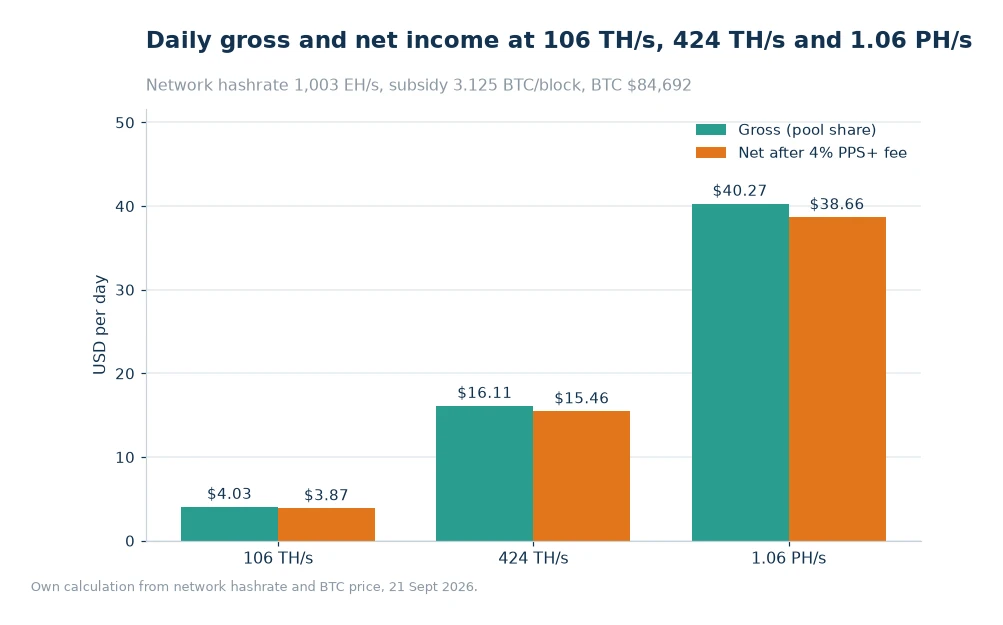
Moving a petahash is not like changing a password. The fleet keeps earning while the decision is made, so the cost of a bad switch is measured in lost days rather than lost capital. At 1.06 PH/s the net credit is $38.66 a day, which means a seven-day trial that goes wrong costs about $270 — far less than a month of pointing the whole fleet at the wrong address.

Key takeaways
- 1.06 PH/s nets $38.66 a day, so a week of trial output is worth about $270.
- Move one aisle first; 106 TH/s is 10% of the fleet and enough to expose routing errors.
- The trial should test withdrawals, alerts and worker naming, not just hashrate.
- Keep the old account funded and open until the new one has paid out twice.
Why a fleet move deserves a trial, not a leap
An established operation has years of accumulated settings: worker names that match physical slots, payout addresses that match accounting codes, alert rules tuned to the building's normal noise. A pool migration resets all of that. The hashrate may recover in an hour, but the operational layer takes longer, and mistakes there are invisible until a payout fails to arrive.
A trial week is a way to discover the mismatches while they are cheap. Point a defined subset at the new pool, keep the rest where it is, and compare the two sets at the end. The comparison is not only about coins. It is about which dashboard told you the truth first when something went wrong.
The size of the subset matters. One machine is too small to reveal a payout threshold issue; the whole fleet is too much to risk on an untested path. A tenth of capacity is a reasonable default, because it produces a meaningful daily figure without committing the site.
Reading pool hashrate against your own share
Public statistics answer a question that marketing cannot: how large is the pool, and therefore how stable is your share of it. A pool with a small hashrate finds blocks less often, which matters more under PPLNS than under an hourly scheme. The number to look at is the pool's total, not its rank.
The ViaBTC Bitcoin Mining Statistics and pool state pages publish hashrate, block history and luck, which makes the comparison possible without asking a salesperson. Read them for a week before moving anything: a pool's behaviour on a quiet Sunday tells you more than its behaviour during a marketing push.
Then compute your own share. At 106 TH/s against a network of 1,003 EH/s, your slice is tiny, and the pool's share of the network is a separate number. Confusing the two is common. The first decides your output; the second decides how often the pool finds a block, which decides the variance around that output. Keep both on the same page of notes, with the date they were read.
Withdrawal terms are part of the trial
A pool can pay well and still be awkward to use. Minimum withdrawal amounts, confirmation waits, address allow-lists and the coin in which you are paid all affect the cash that reaches the business. The trial should include at least one real withdrawal, not a test transaction to yourself, because the friction appears at the edges.
Zero-fee mining payouts remove one line from the cost comparison, but the timing still matters. An operation that pays a monthly power bill needs the withdrawal to clear before the invoice, not after it. Test the timing with a small amount in week one, then scale once the path is proven.
Record the dates. When the trial ends, the question "did the money arrive when expected" should have a calendar answer rather than an impression.
Check the coin as well as the amount. A pool may pay BTC, or the coin your hardware actually mines, and the conversion step between the two is where a small operator loses track. Decide before the trial whether the fleet will hold the mined coin or convert it, and write that decision into the accounting method so the trial result is comparable with the old pool's result.
What a good trial week looks like
Day one is setup: worker names, payout address, alert thresholds and a note of the exact time the first share was accepted. Days two to five are observation: hashrate against the old pool, stale-share rate, any rejected shares and the shape of the daily credits. Day six is a withdrawal test. Day seven is a review against the numbers written down at the start.
The review should answer four questions. Did the new pool credit within the expected range? Did the alerts fire when a test machine was stopped? Did the withdrawal clear on the expected day? Would the person on night shift be able to diagnose a fault from the new dashboard alone?
A failed answer does not necessarily end the trial. It may mean the alert thresholds need tuning or the worker names need a better convention. What it should prevent is a decision made on hashrate alone.
| Slice | Hashrate | Daily net | Days to 0.01 BTC | Share of fleet |
|---|---|---|---|---|
| One aisle | 106 TH/s | $3.87 | 218.8 | 10% |
| Four aisles | 424 TH/s | $15.46 | 54.8 | 40% |
| Full hall | 1.06 PH/s | $38.66 | 21.9 | 100% |
Worked example
Price the trial at the aisle level, then scale it to the hall.
- Take the 450 BTC issued daily and divide by 1,003,000,000 TH/s to get 0.00000044865 BTC per terahash.
- At 106 TH/s: 106 × 0.00000044865 = 0.00004756 BTC a day.
- At $84,692: 0.00004756 × 84,692 = $4.027 gross.
- After the listed 4%: 4.027 × 0.96 = $3.866, or $3.87 net.
- Seven days of trial: 3.866 × 7 = $27.06.
- Full hall at 1.06 PH/s: 38.66 a day, so a week is $270.62.
- Days for the full hall to accumulate 0.01 BTC: 0.01 ÷ (38.66 ÷ 84,692) = 21.9.
The $27 trial cost at aisle level is the number to hold against the value of the information. If the trial prevents one day of full-hall downtime, it has already paid for itself ten times over. That asymmetry is the argument for doing it properly rather than rushing the migration.
Frequently asked questions
How much should I move for a pool trial?
Around a tenth of capacity is a useful default: at 106 TH/s of a 1.06 PH/s fleet the trial costs about $27 a week and still exercises payouts, alerts and worker naming. One machine is too small to expose threshold issues.
What should the trial measure besides hashrate?
Withdrawal timing, alert behaviour, stale-share rate and whether a night-shift operator can diagnose a fault from the new dashboard. Hashrate alone will recover quickly even when the operational setup is wrong.
When can the old account be closed?
After the new pool has paid out at least twice and the withdrawal has cleared on the expected day. Closing earlier removes the fallback precisely when a migration problem is most likely.
Keep the old account open until the trial closes
A migration is reversible only while the old path exists. Leave the previous account funded, keep its payout address valid and do not cancel hosting or forwarding until the second payout has landed. The cost of keeping it for an extra fortnight is trivial next to the cost of having nowhere to go.
Write the trial result on one page and file it with the fleet's records. The next migration, whether in a year or after a management change, will start from that page instead of from memory.
Sources: the ViaBTC homepage, statistics and pool state pages for public network data and pool behaviour[1]. Numbers read on 21 Sept 2026: 1,003 EH/s network hashrate, difficulty 132.76 T and BTC $84,692. Published 24 Oct 2026.