
Hitivi · Field Notes
What testing methods are used to validate hdi pcb quality?
In the high-speed digital age, an HDI PCB the size of a palm may integrate over 20,000 micro-vias, and its quality verification is like conducting a full-body magnetic resonance scan for precision integrated circuits. The automatic optical Inspection (AOI) system captures board surface images at a speed of 50 million pixels per second, capable of identifying circuit defects as small as 15 microns, reducing the missed detection rate of appearance defects from 5% in traditional manual inspection to 0.01%. A case of a certain medical equipment manufacturer in 2023 shows that by introducing 3D-AOI technology, it has increased the detection rate of the tombplate defect of 01005-sized components to 99.95%, and reduced the early failure rate of the pacemaker control board from 200 per million to 50 per million.
Electrical performance testing constitutes the neural network for quality verification. The flying probe tester scans network connectivity at a speed of 3,000 test points per minute, with an impedance control accuracy of ±5%, while the time domain reflectometer (TDR) can detect timing deviations of 1 picosecond in signal transmission. When the test frequency reaches 10GHz, the vector network analyzer can measure a deviation of insertion loss not exceeding -0.8dB, which is crucial for high-frequency HDI PCBS used in 5G base stations. For instance, a certain base station equipment manufacturer optimized the signal reflection coefficient from 15% to 3% through 100% impedance testing, thereby increasing the millimeter-wave transmission efficiency by 12%.
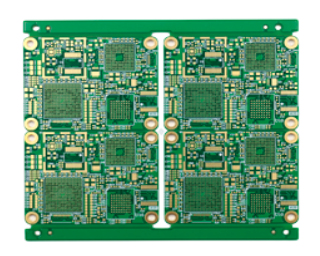 The verification of microstructure relies on cross-sectional analysis and X-ray detection. Industrial CT can generate three-dimensional tomographic images with a resolution of 2 microns, accurately measuring whether the depth-to-diameter ratio of micro-holes is controlled within a reasonable range of 0.8:1 to 1.2:1. The thermal stress test involves placing the samples in an environmental chamber at -55℃ to 125℃ for 1,000 cycles. It is required that the copper coating with holes remain crack-free after 500 cycles, and its tensile strength should be maintained at over 200MPa. The wet heat bias voltage test was conducted in accordance with the JEDEC standard. Under the conditions of 85℃ and 85% humidity, a 100V voltage was applied for 500 hours, and the insulation resistance value must always be above 100MΩ.
Signal integrity verification is a core checkpoint for high-end HDI PCBS. The eye diagram test requires that at high data rates such as 56Gbps, the eye diagram opening degree should reach above 0.7UI, and the jitter value should be less than 1.5ps. The practice of a certain artificial intelligence server manufacturer shows that it has increased the eye height of a 32Gbps signal from 120mV to 180mV through TDR impedance consistency control, and the bit error rate has improved by two orders of magnitude. Ultimately, the accelerated life test simulates a 10-year usage cycle, keeping the failure probability of HDI PCBS within 0.005% under extreme loads. This strict quality verification system is precisely the lifeline for the reliable operation of electronic devices.
The verification of microstructure relies on cross-sectional analysis and X-ray detection. Industrial CT can generate three-dimensional tomographic images with a resolution of 2 microns, accurately measuring whether the depth-to-diameter ratio of micro-holes is controlled within a reasonable range of 0.8:1 to 1.2:1. The thermal stress test involves placing the samples in an environmental chamber at -55℃ to 125℃ for 1,000 cycles. It is required that the copper coating with holes remain crack-free after 500 cycles, and its tensile strength should be maintained at over 200MPa. The wet heat bias voltage test was conducted in accordance with the JEDEC standard. Under the conditions of 85℃ and 85% humidity, a 100V voltage was applied for 500 hours, and the insulation resistance value must always be above 100MΩ.
Signal integrity verification is a core checkpoint for high-end HDI PCBS. The eye diagram test requires that at high data rates such as 56Gbps, the eye diagram opening degree should reach above 0.7UI, and the jitter value should be less than 1.5ps. The practice of a certain artificial intelligence server manufacturer shows that it has increased the eye height of a 32Gbps signal from 120mV to 180mV through TDR impedance consistency control, and the bit error rate has improved by two orders of magnitude. Ultimately, the accelerated life test simulates a 10-year usage cycle, keeping the failure probability of HDI PCBS within 0.005% under extreme loads. This strict quality verification system is precisely the lifeline for the reliable operation of electronic devices.
The verification of microstructure relies on cross-sectional analysis and X-ray detection. Industrial CT can generate three-dimensional tomographic images with a resolution of 2 microns, accurately measuring whether the depth-to-diameter ratio of micro-holes is controlled within a reasonable range of 0.8:1 to 1.2:1. The thermal stress test involves placing the samples in an environmental chamber at -55℃ to 125℃ for 1,000 cycles. It is required that the copper coating with holes remain crack-free after 500 cycles, and its tensile strength should be maintained at over 200MPa. The wet heat bias voltage test was conducted in accordance with the JEDEC standard. Under the conditions of 85℃ and 85% humidity, a 100V voltage was applied for 500 hours, and the insulation resistance value must always be above 100MΩ.
Signal integrity verification is a core checkpoint for high-end HDI PCBS. The eye diagram test requires that at high data rates such as 56Gbps, the eye diagram opening degree should reach above 0.7UI, and the jitter value should be less than 1.5ps. The practice of a certain artificial intelligence server manufacturer shows that it has increased the eye height of a 32Gbps signal from 120mV to 180mV through TDR impedance consistency control, and the bit error rate has improved by two orders of magnitude. Ultimately, the accelerated life test simulates a 10-year usage cycle, keeping the failure probability of HDI PCBS within 0.005% under extreme loads. This strict quality verification system is precisely the lifeline for the reliable operation of electronic devices.